PDF + EPUB
12.4 MB
Licence personnelle
324 pages
Machine Learning & AI
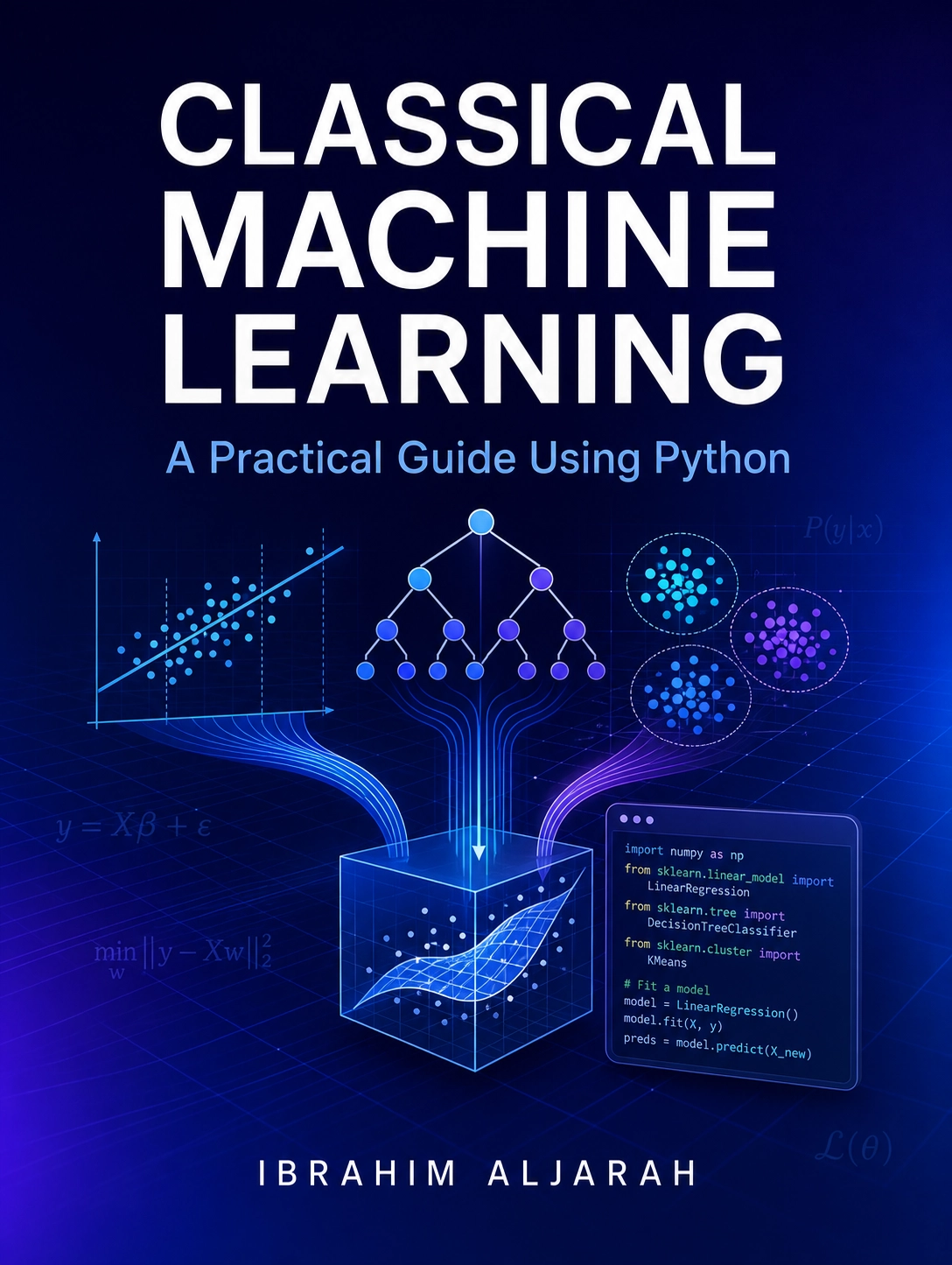
Téléchargement numériqueClassical Machine Learning: A Practical Guide Using Python
Build a strong foundation in classical machine learning through clear theory, essential mathematics, and hands-on Python implementations using NumPy, pandas, scikit-learn, and TensorFlow.
Classical Machine Learning: A Practical Guide Using Python provides a clear and practical foundation in one of artificial intelligence’s most important branches.
As machine learning grows increasingly complex through deep learning and generative models, the book returns to the foundational ideas that make modern AI possible. It explains classical models intuitively and pairs the theory with hands-on Python implementations.
What the book covers
• Linear regression and logistic regression
• Decision trees and ensemble methods
• Clustering and dimensionality reduction
• Neural networks and convolutional operations
• Emerging ideas such as Cubixel representation in image processing
• Theory, mathematics, code, and practical implementations
The chapters build progressively, combining conceptual explanations with mathematical foundations and code. Practical examples use widely adopted Python libraries including NumPy, pandas, scikit-learn, and TensorFlow.
Recommended background
Readers should have working knowledge of Linear Algebra and Calculus because many algorithms rely on these mathematical foundations. A solid Python foundation is also recommended.
This book is designed for aspiring machine learning engineers, data scientists moving from another field, students, researchers, professionals, and academics who want to strengthen or refresh their classical machine learning knowledge.
Product details
Author: Ibrahim Aljarah
Publisher: Springer
Edition: 2026
Release date: August 21, 2026
Language: English
Length: 324 pages
Formats: True PDF and True EPUB
ISBN: 103032043980
USD 19.99
Voir le panier & Paiement
Achat sécuriséAccès après confirmation du paiement · Jusqu’à 5 téléchargements
Avant d’acheter
Vérifiez que ce produit convient à votre méthode de travail.
Des conditions claires
Sachez exactement ce que votre achat comprend.
Licence
Usage personnel pour un acheteur. La revente, la redistribution et le partage des fichiers sources sont interdits.
Lire la licence complète →Remboursements
Les achats numériques sont normalement définitifs après la remise de l’accès. Un fichier défectueux ou mal décrit sera corrigé, remplacé ou remboursé lorsque requis.
Lire les conditions de remboursement →Assistance
L’assistance couvre l’accès aux fichiers et l’installation documentée. Le travail personnalisé et la formation au logiciel ne sont pas inclus sauf indication contraire.
Mises à jour gratuites
Aucune mise à jour future n’est promise. Vous recevez la version décrite sur cette page.
FAQ
Questions fréquentes
Who is the author?
Ibrahim Aljarah.
Who is the publisher?
Springer.
What edition is included?
The 2026 edition.
How many pages are included?
324 pages.
Which formats are included?
True PDF and True EPUB.
What prior knowledge is recommended?
Working knowledge of Linear Algebra, Calculus, and Python.
Which Python libraries are used?
NumPy, pandas, scikit-learn, and TensorFlow.
What topics are covered?
Regression, decision trees, ensemble methods, clustering, dimensionality reduction, neural networks, convolutional operations, and more.
Dans le produit
Tout ce dont vous avez besoin.
Rien de superflu.
Build a strong foundation in classical machine learning through clear theory, essential mathematics, and hands-on Python implementations using NumPy, pandas, scikit-learn, and TensorFlow.
Vous aimerez aussi
Continuez à créer.
 Téléchargement numérique
PDF
Téléchargement numérique
PDF
Machine Learning & AI
Python 3 and Machine Learning Using ChatGPT / GPT-4
Learn Python data analysis, machine learning classifiers, GPT-4-assisted regression, and AI-powered data visualization through practical tutorials and companion code, datasets, and figures.USD 14.99